Showing posts with label T90. Show all posts

Tuesday, 9 April 2013

RIP Margaret Thatcher

Margaret Hilda Thatcher, Baroness Thatcher, LG, OM, PC, FRS was a British Conservative Party politician who was Prime Minister of the United Kingdom from 1979 to 1990 and the Leader of the Conservative Party from 1975 to 1990.

Book of condolence at Grantham library

I remember photographing Mrs Thatcher receiving the freedom of the city of London back in May 1989. At the time I was freelancing for some eleven different publications. My remit on this day was to cover it for the City of London Recorder newspaper
 
The press pass that I was issued with allowed me a position right at the back of the ceremonial hall on a balcony about ten meters high with three other 'togs.

Press pass

No flash and no tripods was the order of the day so that meant high film speed. The event was also being covered by television so there was just enough light to get away with using 1600 ISO.

My next problem was the timing. I had to get the images to the newsdesk as soon as possible. In those days I would usually drop off my unexposed films to the various newspaper's darkrooms and have them process and print them up for me. The city of london Recorder was a small publication and didn't have any darkroom facilities. I solved the problem by booking myself some darkroom time at the Photographers Gallery about half a mile from the event itself. Back then, you could hire a communal darkroom for a couple of hours for quite a cheap price and it was quite near to where the event was taking place.

To further save time, I decided to use Ilford XP2 chromogenic film. This was becoming my main black and white film for newspaper use when time was of the essence. Although it was monochrome, it could be developed in C41 chemistry of the type usually used for colour negatives. It also had an extremely wide exposure latitude. In essence, this meant that i could do a job in bright sunlight with my camera meter set at 100 ISO, go to my next job indoors and use 400 ISO and then finish off shooting a floodlit football match at 1600 ISO . . . ALL ON THE SAME ROLL!

So on the day, I turned up early (as I tried always to do) and was shown to the small balcony that I'd be sharing with my three colleagues representing her majesty's press. I could see why tripods weren't allowed. There was barely room to stand. As I was first to arrive, I blagged the position by the railing.

Soon after, my three companions arrived and began complaining about the space allotted to us. I didn't mind because I was in front :o)

Then the ceremony began and we noticed another problem. Mrs Thatcher was wearing a wide brimmed hat. From our vantage point at the back of the building and from ten meters high, we could only see her chin! 

This meant that we had to constantly look through the viewfinder and be ready to fire off a burst when she glanced up. I was using my canon T90 coupled with a 300 mm f4 telephoto lens which was ideal. As a form of insurance I took photos of the other dignitaries in the audience in case I wasn't able to get an image of the lady herself.

In the event, I shot a full 36 roll and only got her face on three exposures but this was enough for me. When the ceremony ended, I took off to the nearest photolab and had my negatives processed. From there I ran to the Photographers Gallery and ran off five or six, ten by eight enlargements which I delivered to the editor two hours after the event and well before deadline.


Both images. Canon T90 EF 300mm f4
1/125sec @ f4 1600 ISO


 This was used large in the 'paper

So that was my small experience photographing "The Iron Lady". As I heard someone on the television this morning, "Like her or loathe her, she won't be forgotten. "

Thanks for reading.


Wednesday, 1 December 2010

My reputation was saved by a ZSD.

Last week I was looking through some of my old press stuff from the days in the early eighties when I freelanced in London for some twelve different publications.

Looking at the images bought back many memories of various jobs and situations etc, which I'm quite happy to share here (even the embarrassing ones).

One job in particular sprang to mind. I was asked to provide pictures in  colour for Hello magazine and black and white for the City of London Recorder newspaper.

The job itself was to photograph the Queen visiting the New Royal Mint premises.

On the day of the visit, I arrived in plenty of time and secured myself a good vantage point. The photo pass that I was issued only allowed me to photograph the Queen outside.  The indoor shots would be taken by another photographer

I was using my Canon A1 and the T90.The A1 was loaded with Ilford HP5 black and white film rated at 400 and the T90 was filled with Ektachrome 400 slide film. My reasons for the film in each camera was that I wanted to use the spot metering capability in the T90 to make sure that I was exposing correctly for the skin tones. Essential with unforgiving slide film.  The black and white, I would develop myself later as the newspaper was only printed once a week.

I opened the back of the A1 and threaded the film tongue into the take up spool, wound one frame on and then closed the back. I then fired off a couple  more frames until the mechanical counter showed number one in the small window.  Then I opened the back of the T90 and laid the tongue of the Ektachrome film against the take up spool. I closed the door and heard the film being automatically loaded. Thus set, I waited for The Queen to arrive.

HM always attracts a good crowd and I shot lots of pics of her with her subjects alternating between the two cameras. My window of opportunity was however all too brief and before a few minutes had passed, the Queen had gone inside.

I looked at the film counters on both cameras. The A1 had made 27 images and the T90 was nearly full with 34 frames gone. I put both cameras back in my bag and drove to Joe's Basement in Wardour Street SOHO to have the slide film developed. Joe's was a photolab that was open 24 hours a day. You could go in at one o'clock in the morning, hand in your slide film and have it back two hours later. They also did push processing, printing, mounting and lots of other photography related things.

I gave my film over the counter at 11:00 o'clock and was told that it would be ready by one. This was ideal because I had an appointment to hand in the best slides to the magazine at two thirty.

This meant I could go home, get some lunch, come back and pick up the slides then take them to the magazine with plenty of time to spare.

When I got home, I took the A1 from my bag and went to rewind the film. I pushed in the tiny film release button and lifted the lever on the film spool to begin the process.

Normally, for a thirty six exposure film, I would have to turn the handle about thirty or so times until it went slack, indicating that the film was back safely inside the cannister. This time however I felt the tension loosen after about two turns!

Shock!

Horror!

This could only mean one thing. The film had not gone through the camera. I had no black and white images for the newspaper. I felt sick. In the photography world, you are only as good as your last job. I had made a stupid amateur mistake and would be a laughing stock. No-one would employ a freelancer who didn't check if his film was loaded. What could I do? I began to formulate excuses but each one sounded more absurd that the previous one.

Then I had an epiphany. A simple solution came to me. I remembered that a couple of months  previously, I had bought myself an Ohnar Zoom Slide duplicator (ZSD) from Jessops photoshop on Tottenham Court road. This was a tube, containing a fixed focus lens at f22 that fitted on the front of an SLR and enabled the user to insert a slide at the front end in order to take a picture of the resuting image. There were two types. A fixed focal length and a zoom version. I had paid about £25 for the zoom version.

 Zoom slide duplicator. Image by Delgibo on Flickr


It was now nearly time for me to pick up the slides from Joe's. I grabbed my T90 , the ZSD and a roll of HP5 then made my way to Wardour Street. The slides were in my possession at one fifteen.

At about one thirty,  I made my way to one of the sit down cubicles in the mens toilet at Hello magazine. The next half an hour or so, saw me sitting on the toilet with my camera, ZSD attached,  pointed at a light bulb. I fed the best slides into the ZSD, zoomed in to crop and pressed the shutter, thus making a black and white copy of each colour image.

At two twenty five, I was able to hand over the colour images to the picture editor at Hello magazine.

That evening, I processed and printed the black and white images and handed the pics to my editor.


 Colour image from T90
Black and white copy from ZSD

 Ektachrome original

HP5 copy from ZSD


Reputation intact. Until next time that is!   ;o)


Wednesday, 18 August 2010

My camera family tree. The FD era. Part 0ne

I was looking through the cameras for sale on Ricardo.ch which is a Swiss version of Ebay.

Just looking. But one particular camera body caught my eye. It was the “legendary“ Canon  T90. Designed by famous Italian designer Luigi Colani. The last professional level manual-focus camera from Canon, and the last professional camera to use the Canon FD lens mount.

It was a beautiful camera then and it still looks futuristic today. This got me thinking about other cameras I have owned over the years and what I thought of them.

The first camera I ever used was a Halina Paulette electric. It belonged to my dad and he loaned me it when I went on holiday to South Africa with the school. I must have been about 13 or 14 years old.

Image by "Just Curt" on Flickr


I was living in Rhodesia at the time and because of sanctions on that country, film was expensive and hard to come by. My dad loaded it with a 24 exposure roll of 35mm. Enough for two weeks holiday.

He ran me through the basics of using the distance scale on the lens, then using the needle in the viewfinder together with the aperture and shutter speed rings on the lens, how to set the exposure.

I had a great holiday and was the only of our group of about thirty boys to have a camera.

Fast forward to 1979. I was in England, it was Christmas and my folks asked me what I wanted for a present. I chose a Russian Zenit E camera. I think that my only criteria for choosing this camera were because my dad told me that “you can change the lenses without fogging the film”. Technical stuff indeed.
Zenit E with Industar 50mm f3.5
My camera was equipped (as in the above example) with an Industar 50mm f3.5 lens. As with the Halina, you had to use match needle metering to set the exposure. First you would focus with the lens set to its widest (f3.5) aperture, Then  select a suitable shutter speed and turn the aperture ring on the lens until the needle hovered in the middle of the display. At first I thought that the darkening of the lens was a special effect to give a “night time” feel to the pictures. It was useful however because it taught me better than any book can about the relationship between shutter speed and aperture.

The Zenit was built like a tank. I bought myself some additional lenses, a 35mm and a 135mm and my fate was sealed. I was hooked.

I began to photograph anything and everything. From sports events to friend’s portraits. At sports events, it would take me 11 seconds to change lenses. The lenses in question had a 42 mm screw thread mount.

As my interest in photography grew, I began to devour anything I could about photography. I took books from the library, I bought books on the subject (some of which I still have), I spent all my spare money on photographic magazines. I also shot almost exclusively in Black and White. I joined a local camera club and picked up hints and tips to feed my growing hunger for photographic knowledge.

As my interest grew, so did my desire to have a ”better“ camera. One day, I saw an advert from the electronics shop, Dixons, for a Chinon CM-3 camera with powerwinder. I went to the shop and played around with a demo model and immediately fell in love with it. 


Again, as I was out of work and trying to freelance, my wonderful parents helped me with the purchase of the camera. This camera was the business!! It had a traffic light system of light metering plus the enormous advantage of not having to stop the lens down before taking a picture. All you had to do was focus, and then turn the lens aperture ring until the middle green LED lit up. However, the biggest kick for me was the powerwinder. This was Chinon’s name for an autowinder. It had controls on it such as an intervalometer  which allowed the taking of pictures every 1, 2, 4, 8, 15, 30 seconds and you could tell it how many frames you wanted exposed 4, 8, 12, 16, 24. Heady stuff for an impressionable photojunkie such as myself.

For a while I used the Zenit and the Chinon side by side as they both had the same M42 lens mount. Eventually though I picked up another Chinon and sold the Zenit. Now I felt really professional!

I began to take more and more pictures. My work improved and one day a ballet dancer friend of mine asked me to photograph her for an upcoming production. I remember photographing her in the sitting room of a derelict house with a stocking stretched over my lens to give a soft focus effect. She was pleased with the results and they went on display (with my name of course) in the front window of the local bank.

I began to receive bookings for weddings and other types of social photography from people who had seen the images and the work slowly started to increase in volume.

Although freelancing can be interesting, I was constantly looking for something a bit more stable so I answered an advert in the back on one of the photographic magazines for a portrait photographer wanted in Stuttgart, Germany.

I had forgotten all about it until a month or two later I received a phone call from the studio owner telling me that he loved the example pictures that  had sent him and would I like to come over to Germany to work for him.

The job in Germany wasn’t quite what I expected (or was led to believe). It involved door to door canvassing from Monday to Friday on American army bases in (what was then) West Germany.

Days were spent cold calling and trying to make appointments to come back in the evening to persuade the family to book a portrait session. Saturdays and Sundays were taken up with photographing the family’s who had booked us.

This wasn’t quite what I had in mind so after a few months I quit. I didn’t however want to go back to the UK with my tail between my legs so I decided to stay in Stuttgart. In order to save money (for film of course ?), I slept for three days in a row in a youth hostel (the maximum time allowed) followed by a couple of days in my car. Alternating between the two. This lasted for two months until one day, a friend told me that the photographer at the local army base was going back to the States. I decided to try my luck and went for an interview.

I was taken on as an (civilian) American Army photographer based at the Public Affairs Office. This was 1982.


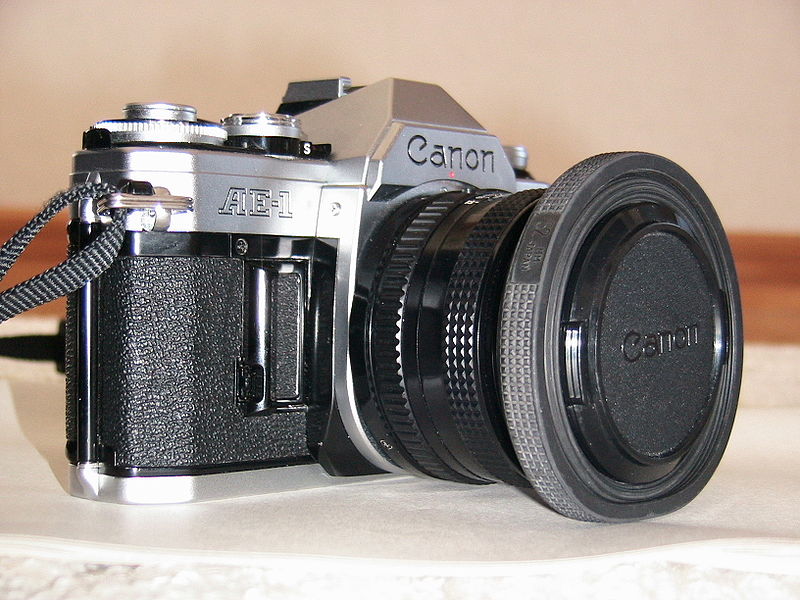
This was a fantastic time for me. I was photographing everything from portraits, sports days, military manoeuvres, medal presentations and newspaper stuff to send back to the states. I sold my two Chinons and treated myself to a new Canon AE1.


The AE1 was shutter priority or manual. I preferred shutter priority as I favoured action photography. My work camera (the camera supplied for my job), was an original Canon F1


This came in a metal case with lots of accessories including hoods, finders etc. It (like my first Zenit) was built to take knocks. I was in camera heaven. They also thoughtfully supplied a 35mm and a 135 mm which also fitted my AE1.

My quest for more photography experiences led me two years later to quit the job and fly to South Africa on spec.

Before I left the Army job I was presented with an official commendation by the US government for my photographic work.

I immediately found a job in South Africa doing progress photos at a paper mill owned by SAPPI Fine Papers which was bang in the middle of the bush at a place called Ngodwana. It was a six month contract and I loved it. Again it was a new experience. I also had to attend a video making course.

When the contract finished, I found work in Johannesburg with the Electricity Supply Commission (ESCOM). Another great job with interesting people. Varied and interesting work including regular flights over the bush in a Bell Jet Ranger helicopter and all sorts on other photography including forensics, portraits, progress stuff etc.

Best of all, they had a fully stocked photo equipment cupboard.


I was issued with two Nikon F3’s and a selection of lenses plus a Metz 60 series flash gun. 


Unfortunately the F3’s weren’t up to the job. In six months I went through six bodies. Just little things like the metering wouldn’t meter or the flash synch wouldn’t fire the flash or readings would show false information etc. I went back to using my own Canon and as a treat I bought myself a Canon A1 with the Motor drive MA. The Motor drive added bulk to the body but improved the handling especially when shooting vertically. One particular feature that I loved was that when shooting in single frame advance, you could immediately change to high speed advance simply my pushing in a small white button that fell naturally under your little finger.


My time at ESCOM came to an end due to my “itchy feet” syndrome and I moved to the UK. London in particular. After a spell as a photolab manager I decided to freelance in London. I was doing everything from door-stepping to breaking news, demos and the inevitable “grip ‘n grin” pics.

It was around this time that the T90 (as mentioned at the beginning of this article), appeared on the market. So I sold my beloved AE1 and purchased the Colani designed masterpiece.


It was small, Light, all curved design with six integrated motors to handle rewind, film advance, shutter cocking etc. The amazing thing was that all this came from only FOUR penlight batteries!!

I loved it so much that I sold the A1 and bought another T90 body.

But the FD lens mount era was drawing to a close. It was 1987 and something big was stirring in the world of Canon photography.....

Tune in later for part two

Till then. Keep shooting.