Passes. they get you into exclusive places and help you get unique images right? Maybe.

I was recently going through some of my old notes and photos from early on in my career and I came across notes that I had made regarding my day to day activities.
Working for one local county paper at the time it is now amazing to me to see how many jobs I would have to cover in a day.


Two pages from 1991
Obviously for these jobs it was just a case of locating the place on an A -Z map, driving there, finding parking, locating the subject and photographing them then going on to the next job. As you can see from the entries there was sometimes very little time between each job. It meant I had to have a preconceived idea of the picture I wanted and not repeating it for every job of that day / week.
Most of these jobs were standard local newspaper fare. Charity stuff, wedding anniversaries, "local boy does good" and cheque presentations (a.k.a.grip 'n grin), normally with a ridiculously oversized cheque.
The other jobs however, the "important" jobs where there would be national interest meant that a Pass was needed.
My first experience with press passes came in 1985 when the first Live Aid concert was staged in Hyde Park. A friend of mine had a photography pass and he let me see it. It was roughly the same dimensions as a standard 6" x 4" (10 x 15 cm) paper print which gave me an idea . . .
I photographed the pass with my T90 which was holding my 50mm lens to which I attached a couple of canon close up filters. I made sure that the pass completely filled my field of view and took a shot. This I processed in a one hour mini-lab, laminated it and hey presto, I had a counterfeit press pass for live Aid!
Other occasions however, required a bit more legitimacy. It used to be (back when I was an active press photographer in London) that if you were photographing government or royalty you would need a rota pass. This was issued by the C.O.I ( Chamber of Information ) and normally on a first come, first served basis.
One pass was given each to a monochrome and colour photographer with others going to TV and foreign press members. There would be separate passes for the entrance, the interior and the exit.. All these passes were issued with the proviso that all images were made available to any media organisation that required them for a period of up to two years.
The passes varied from the elaborately printed to the craftshop specials and there never seemd to be any logic behind it. For instance, when I photographed ex Russian president Gorbachev's visit to the UK back in 1989, I had to be vetted by Scotland Yard, have a specially printed press card and three other passes. The closest I got to him was 50 yards (45 meters) away.

Passes for the Gorbachev visit.
Whereas a couple of months later I took this picture of the Queen with a pass that looked like it had been made by a six year old!


HM The Queen and the pass I needed to get close.
With the right organisation behind you and a proven track record as a photographer, you will be able to get a pass and get (sometimes) access to the famous people. Although having said that, my best picture of Gorbachev came when I was out with my camera and saw him doing an impromptu walkabout.
Some passes were actually quite ridiculous. I was covering the Tall Ships race back in 1993 in Newcastle and was duly given an all "areas pass" which was required to have visible at all times. This pass was HUGE! This is a picture of it lying next to my mobile phone.
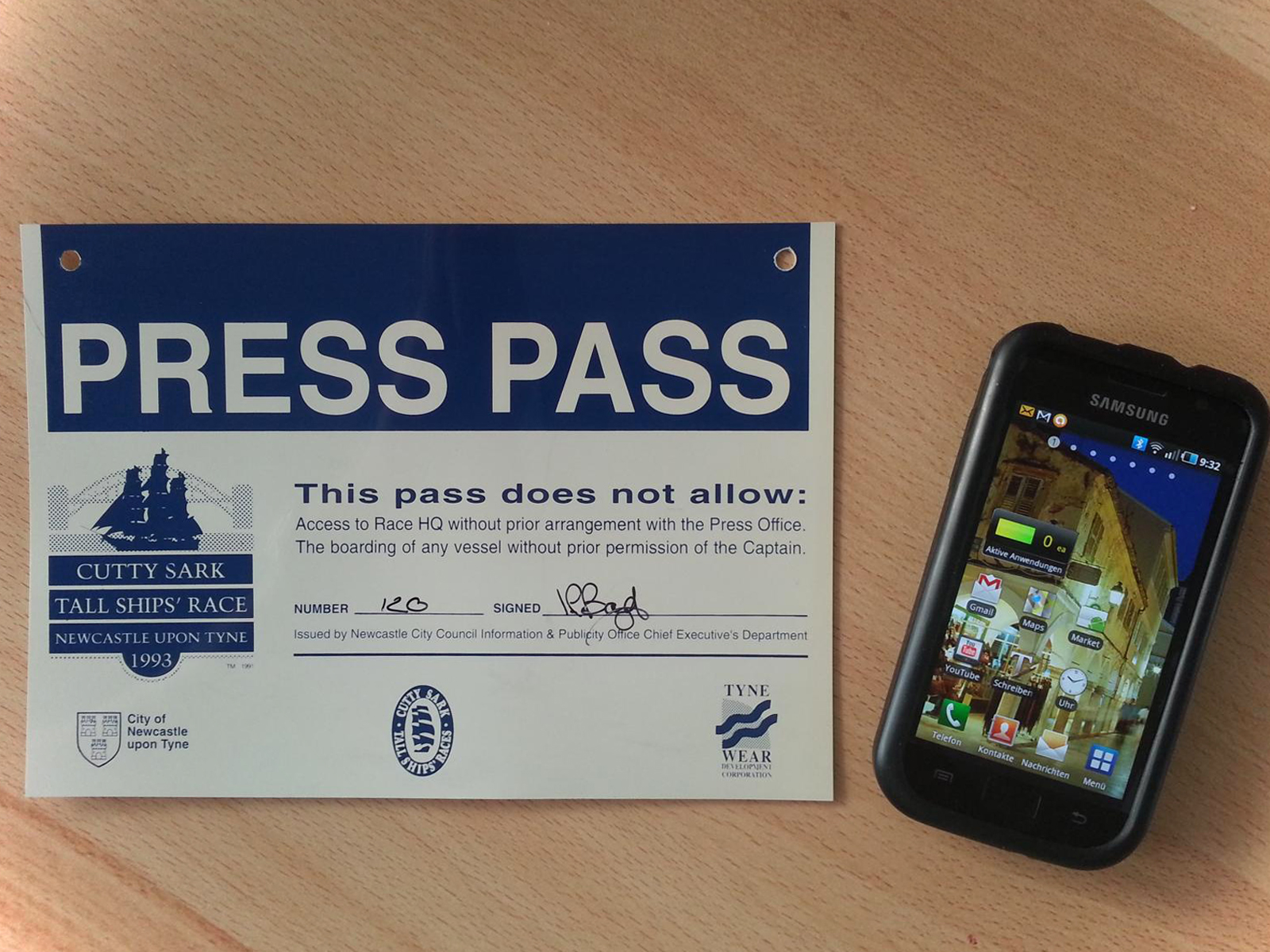
Like wearing a sandwich board!
Here are some of the other passes from my collection.

Various royal passes

Various installation passes.

Pass to photograph Mrs Thatcher
I was prompted to write this article after going to photograph a bank in Basel which was still under construction. I arrived at the reception, explained myself to the two security guards, filled out some forms and was solemnly handed this pass!

Thanks for reading.


