Showing posts with label 5dmkII. Show all posts

Thursday, 6 December 2012

Extasia 2012 - Switzerland shows its naughty side

It's that time of year again. The annual Extasia erotic fair (Erotikmesse) was held in Basel at the end of November.


The event is held inside the ice 
hockey arena in Basel

This time I was taking pictures for a website that must (at the moment) remain nameless. 

I photographed the same event last year

The only difference between this year and last year, apart from some of the acts of course was the fact that I was able to "field test" my new 24 - 105 lens.

I attended on the Friday opening night which, in my opinion is best for photography as it's less well attended meaning more space to move around and photograph.

On my EOS 5d MKII I mounted the flash and the 17 - 40. This lens is ideal for close up action and when you can't move amongst a throng of photographers*. On my 7d I mounted a Speedlite and the 24 - 105 which, due to the crop factor gave the equivalent of a 38 - 168.

I was really impressed with the autofocus speed of this lens. It focussed quick and silently. The image stabilisation also worked like a charm for the few occasions when I wanted to shoot without flash.

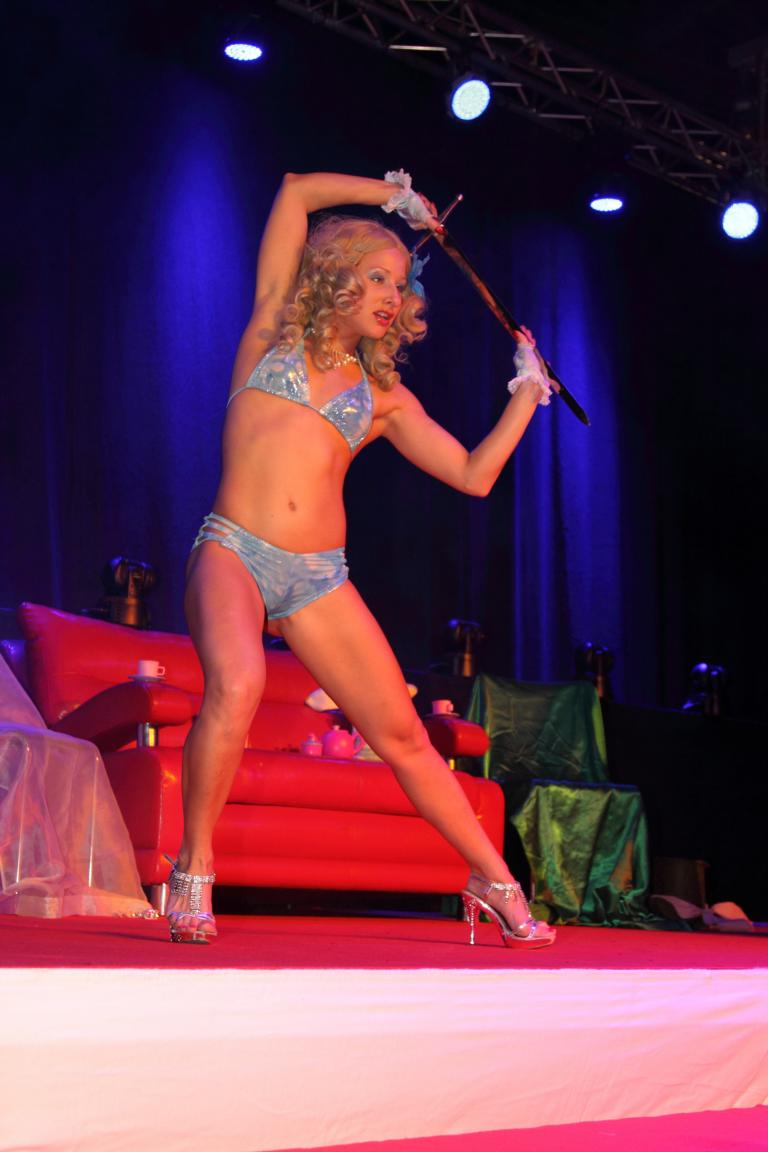
Here are a few impressions of the acts from the evening. I've kept them sfw (safe for work).

   
Get knotted. Japanese rope tying

This is German pornstar Lena Nitro who later 
produced a flag from seemingly nowhere.


 Marcello Bravo and his real life
 partner Hally Thomas


 The Annex fashion show team

 Hally Thomas with her solo act


For these images showing  two of the pole dancers from the FKK club in Basel, I switched the Speedlites off. The image on the left was taken with ISO 400 at an exposure of 1/400sec @f9 on my EOS 5d MKII. The image on the right is a happy accident. I used 1/2 sec @f4 on the 7d. I  personally like the blurring.


I saw this table on the way out full of flyers. Anyone want to buy a swingerclub?

Thanks for reading.


* what exactly is the collective noun for a group of photographers? Answers in the comments please.

Monday, 3 December 2012

Christmas lights

My friend , lighting designer Renato De Toffol was awarded the contract to design and set up the Christmas lights for the city of Olten near where I live.

The lights are beautifully designed and consist of "curtains" of fairy lights and large translucent balls which project stars onto nearby surfaces.

It was bitterly cold when I was photographing the lights and once or twice my 5D MkII wouldn't respond. This was solved by removing the battery from the camera and keeping it in my jacket for a while to warm up.

My son Thomas accompanied me and I learnt that he has a great eye for potential pictures. He would go off and scout a new location while I photographed the current one.


This is a photo that Thomas took of me standing on a dumpster after he suggested that the image would be better if I had a higher viewpoint.


This is the image that resulted. he was right  :)

Overnight after shooting the images it snowed quite heavily and I thought that it would be a good idea to retake some of the better viewpoints with snow in them.

Unfortunately most of the snow had gone and some of it had turned to slush by the time darkness came, so I was only able to retake a few images using the wet streets for reflections.

One of my favourite images from the night is of a water fountain. I decided to play around with it in photoshop. I took two images with all the same settings. One image was sharp and the other deliberately out of focus.


Both images 2.5 sec @ f11

In Photoshop, I overlaid the blurred image on top of the sharp one. Then I used the standard ersaer tool to "wipe away" the unsharpness on the figure of the lady. I quite like the effect.

The result 

You can see a few more from this shoot over on Renato's website here.

What do you think?

As ever. Thanks for reading and please leave a comment.


Tuesday, 2 October 2012

Out of the comfort zone.

For the last ten years I was doing 90% of my photographic work in the studio.

Using slow reversal film at 64 ISO , I worked with a medium format camera locked down on a FOBA studio tripod which wouldn't budge one millimetre even if you rugby tackled it.

 Foba studio stand

The finished results were intended for brochures, adverts and the internet etc.

I think that the fastest film I had used during that time was rated at ISO 200.

This had to change when I took some pictures at a seminar. The event was held in a former church which had very high ceilings so therefore no bounce flash. Also I didn't want to distract the speakers and the audience with my strobes.

I knew that my Eos 7d and my EOS 5d MKII have good low light capabilities so I decided to shoot at 800 ISO. Not very high, you might think but remember that my previous high ISO exploits were in the UK, over twenty years ago, when I was shooting football in Winter with my camera set at 1600 ISO before half-time and 3200 in the second half. The results which were used in the newspaper were undoubtedly grainy. 

Thoughts like this were in the back of my mind when I decided to shoot at a measly 800 ISO for the seminar.

The four lenses that I used were the EF 17 - 40, EF 28-135 IS,  EF 24mm f2.8 and the EF 50mm f1.4

I started off by photographing every speaker from beside the stage with my 50mm lens. 

Luckily, the first speaker was wearing an outfit that was nearly 18% grey. I spot metered off the jacket and used that reading on the subsequent images of speakers in the same place.


 EOS 7d. EF 50mm f1.4. 1/50sec @ f4. 800 ISO

The crop factor when using the 50mm lens on the 7d meant that it was in effect an 80mm lens

 EOS 5d MKII. EF 28-135 IS 
1/6 sec@ f5.6. 800 ISO


 EOS 5d MKII. EF 24mm f2.8.
1/12 sec@ f4. 800 ISO

For these two shots I waited until the speaker was stationary and not moving his arms etc because the speed was very low. The camera was supported on a G-clamp resting on a table.
 
 EOS 5d MKII. EF 24mm f2.8.
1/13sec@f5. 800 ISO


 EOS 5d MKII. EF 24mm f2.8.
1/15sec@f4.5. 800 ISO


 EOS 5d MKII. EF 24mm f2.8.
1/40sec@f3.2. 800 ISO
Then it was back to the office to convert the RAW data. My standard method is just to correct the white balance, sharpen the final JPG and correct any lens aberrations . These are all done in Canon's own DPP software.
Before and after of the DPP window


All in all a quick easy job that was done without flash. Maybe next time I'll be brave enough to set the speed a little bit higher  :o)


Thanks for reading.

Friday, 21 September 2012

Workhorse. The Vivitar 283

A couple of weeks ago I needed to take some pictures in a hurry and what's more, they had to be illuminated by flash.

No problem. I have two Speedlite 430 EX II's at my disposal. Except I didn't! I had got in late the night before and left my camera case in my car. My camera case is full of the extras that I don't need to carry around all the time in my rucksack. To compound matters, my car was being serviced.

Oh well. There are always solutions that can be found if you think hard enough.

I remembered that I had a Vivitar 283 in my loft. The 283 has been in my possession for over twenty years now. I used it when freelancing back in the UK in the nineties.

A quick trip up a ladder to retrieve the flash and I was soon installing four penlight batteries into it.


I switched it on and was pleased to hear the high pitched whistling noise that denoted the capacitor was filling up. After ten seconds I was rewarded with an orange light which meant that the flash was ready for action.

I set the flash to manual and activated it four or five times to let the flash "*get used to" being on active service again.

Next I had to test it with my EOS 5DII. A quick search on the 'net informed me that the shortest flash synch speed was 1/200sec for shoe mounted flashes. Studio strobes apparently need a slower speed.

I mounted the gun on my camera and took a series of test pictures of Viktoria and Nikita who were on the couch next to me. I began at 1/60 sec which was fine. The flash covered the whole of the sensor without any curtain cut off. 1/125 sec was the same, as was 1/250 sec. The curtain only showed itself when I shot the two children at 1/320sec as you can see from the illustration.

1/125 sec @f5.6

1/250 sec @ f5.6

1/320 sec @f5.6


So anyway. I could use the flash on camera outside at a speed of 1/250 sec without any fear of curtain cut off.

I shot all the test images with the camera set at ISO 400 and an aperture of f5.6. The Vivitar is simplicity itself to use. First you "tell" the unit what film speed you are going to be using. The ISO speed ranges from 25 to 400. Then choose which of four apertures best suits what you're going to be photographing.


Apertures with ISO 400 are 5.6, 8, 16 or 22

 With yellow selected, the aperture to use is 5.6

As you can see, the apertures to use are coloured either yellow, orange, blue or purple.  After choosing a suitable aperture, you select it on the sensor ring which is on the front of the body under the flash head, and take the picture.


The unit can also be used off camera when coupled with the off camera cable.

As I mentioned earlier, I've had my 283 for many years. I'm sure that it's stuill be going strong ten years from now

A quote from Wikipedia which mentions the 283: "
The Vivitar 283 quickly became the number one professional and enthusiast flash unit, outselling all its competitors combined and selling 3,000,000 by 1973. In production for over 30 years, it was twice returned to production after being discontinued in response to customer demand."


There's a very nice review of the 283 to be found here and here

* I know that flashes don't really need to "get used" to anything but I was always told in my younger days to fire the flash a few times if it had been stored for any length of time. Old habits die hard.


Thanks for reading

Tuesday, 7 August 2012

Reflecting on keeping it simple

Back in June and early in July, I wrote about an impromptu photo session with Kristina. The gear I used couldn't have been simpler.

A camera body (in my case, the EOS 5d MKII), a standard 50mm lens, a flash (Speedlite 430 EXII) and a silver reflector.

Although I have a backpack full of camera gear I chose to work as simply as possible because it would make me concentrate on the picture and the framing as I wouldn't be able to zoom back and forth.

The shoot was in my bedroom at home and I spread two black fur blankets on the bed for a minimalist, non intrusive background. 

The bedroom faces west and because the shoot took place in the afternoon, we had strong light coming through the window which wasn't necessarily a good thing!

I posed Kristina mostly with her back to the light source to give her blonde hair some backlighting. This of course threw her face into shadow. This was solved with the aid of my Lastolite reflector. This reflector has been a constant in my camera bag for over twenty years. It is small, light and portable and a great help at "kicking" some light into the shadows.

 The reflector shown folded and open. 
This was the gear used for all three shoots
 
At the start of every pose, I would take a meter reading from her face with my aperture on the camera set to about f4. the ISO was set to 400. The exposure was then noted and transferred to manual mode. This was for two reasons. The exposure was unlikely to change and the wide aperture meant that the background would be slightly out of focus. Because of these parameters, I had to make sure that the eyes were always in focus. That's what people look at first on a portrait.

On this image, the reflector is just in front of  Kristina's 
knees throwing light back onto the face. f3.5 1/400sec

I was so please with the results that a few days later I received a call to take a basic head and shoulders portrait for a magazine story.

Although I had all my gear in the car, I turned up for the shoot with the above equipment.

To better show the difference when using and not using the reflector I took these two pics.
Before and after using the reflector 400 ISO
1/80 sec @f5.6

Of course you don't have to buy a reflector and can make your own. A colleague of mine used to use an A3 sized piece of card with aluminium foil stuck to it. Make sure though that it's the dull side that is reflecting and not the shiny side. The light will be softer and less prone to making your subject squint.
One negative aspect of making an A3 reflector as mentioned above is that it wasn't foldable, was cumbersome in the field and prone to getting scratched, torn etc. my advice would be to get a Lastolite or similar. take a look at their website. They have some interesting tutorials.

That's it for now. Hope you've enjoyed this piece. If you have any questions, please don't hesitate to ask.

Tom


Wednesday, 11 July 2012

Kristina part 2. Another impromptu photoshoot.

I wrote back in June about an impromptu photo session with my sister in law Kristina.

She visited again last week and I managed to persuade her to pose for me again. This time she was less self concious, especially after seeing the finished results from our last time together and this new attitude came across in the photos we made.


As before, I only used my Canon 5dMKII set at ISO 400 and coupled with a 50mm f1.4 lens.  My Speedlite was always bounced from the ceiling and a silver reflector was used to direct light back into her face when her back was facing the (window) light.

The complete set can be found on my website here.

Thanks for reading.