Showing posts with label City of London Recorder. Show all posts

Thursday, 19 December 2013

Passes


Passes. they get you into exclusive places and help you get unique images right? Maybe.


I was recently going through some of my old notes and photos from early on in my career and I came across notes that I had made regarding my day to day activities.

Working for one local county paper at the time it is now amazing to me to see how many jobs I would have to cover in a day.


 Two pages from 1991

Obviously for these jobs it was just a case of locating the place on an A -Z map, driving there, finding parking, locating the subject and photographing them then going on to the next job. As you can see from the entries there was sometimes very little time between each job. It meant I had to have a preconceived idea of the picture I wanted and not repeating it for every job of that day / week.

 Most of these jobs were standard local newspaper fare. Charity stuff, wedding anniversaries, "local boy does good" and cheque presentations (a.k.a.grip 'n grin), normally with a ridiculously oversized cheque.


The other jobs however, the "important" jobs where there would be national interest meant that a Pass was needed.

My first experience with press passes came in 1985 when the first Live Aid concert was staged in Hyde Park. A friend of mine had a photography pass and he let me see it. It was roughly the same dimensions as a standard 6" x 4" (10 x 15 cm) paper print which gave me an idea . . .
I photographed the pass with my T90 which was holding my 50mm lens to which I attached a couple of canon close up filters. I made sure that the pass completely filled my field of view and took a shot. This I processed in a one hour mini-lab, laminated it and hey presto, I had a counterfeit press pass for live Aid!

Other occasions however, required a bit more legitimacy. It used to be (back when I was an active press photographer in London) that if you were photographing government or royalty you would need a rota pass. This was issued by the C.O.I ( Chamber of Information ) and normally on a first come, first served basis.

One pass was given each to a monochrome and colour photographer with others going to TV and foreign press members. There would be separate passes for the entrance, the interior and the exit.. All these passes were issued with the proviso that all images were made available to any media organisation that required them for a period of up to two years.

The passes varied from the elaborately printed to the craftshop specials and there never seemd to be any logic behind it. For instance, when I photographed ex Russian president Gorbachev's visit to the UK back in 1989, I had to be vetted by Scotland Yard, have a specially printed press card and three other passes. The closest I got to him was 50 yards (45 meters) away.


Passes for the Gorbachev visit.
 
Whereas a couple of months later I took this picture of the Queen with a pass that looked like it had been made by a six year old!
 HM The Queen and the pass I needed to get close.

With the right organisation behind you and a proven track record as a photographer, you will be able to get a pass and get (sometimes) access to the famous people. Although having said that, my best picture of Gorbachev came when I was out with my camera and saw him doing an impromptu walkabout.


Some passes were actually quite ridiculous. I was covering the Tall Ships race back in 1993 in Newcastle and was duly given an all "areas pass" which  was required to have visible at all times. This pass was HUGE! This is a picture of it lying next to my mobile phone. 
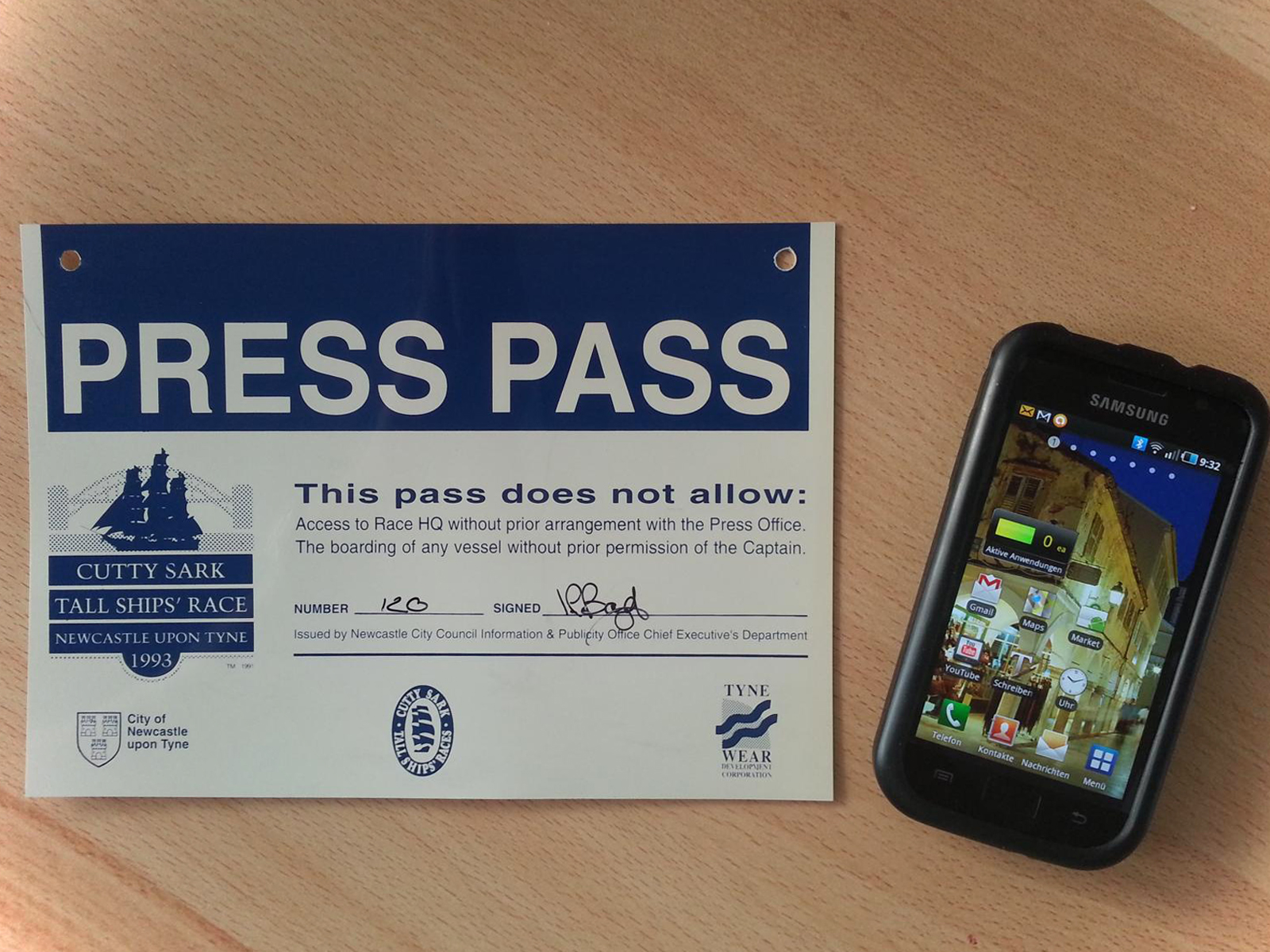
Like wearing a sandwich board!

Here are some of the other passes from my collection.

 Various royal passes


 Various installation passes.


I was prompted to write this article after going to photograph a bank in Basel which was still under construction. I arrived at the reception, explained myself to the two security guards, filled out some forms and was solemnly handed this pass!


Thanks for reading.


Tuesday, 9 April 2013

RIP Margaret Thatcher

Margaret Hilda Thatcher, Baroness Thatcher, LG, OM, PC, FRS was a British Conservative Party politician who was Prime Minister of the United Kingdom from 1979 to 1990 and the Leader of the Conservative Party from 1975 to 1990.

Book of condolence at Grantham library

I remember photographing Mrs Thatcher receiving the freedom of the city of London back in May 1989. At the time I was freelancing for some eleven different publications. My remit on this day was to cover it for the City of London Recorder newspaper
 
The press pass that I was issued with allowed me a position right at the back of the ceremonial hall on a balcony about ten meters high with three other 'togs.

Press pass

No flash and no tripods was the order of the day so that meant high film speed. The event was also being covered by television so there was just enough light to get away with using 1600 ISO.

My next problem was the timing. I had to get the images to the newsdesk as soon as possible. In those days I would usually drop off my unexposed films to the various newspaper's darkrooms and have them process and print them up for me. The city of london Recorder was a small publication and didn't have any darkroom facilities. I solved the problem by booking myself some darkroom time at the Photographers Gallery about half a mile from the event itself. Back then, you could hire a communal darkroom for a couple of hours for quite a cheap price and it was quite near to where the event was taking place.

To further save time, I decided to use Ilford XP2 chromogenic film. This was becoming my main black and white film for newspaper use when time was of the essence. Although it was monochrome, it could be developed in C41 chemistry of the type usually used for colour negatives. It also had an extremely wide exposure latitude. In essence, this meant that i could do a job in bright sunlight with my camera meter set at 100 ISO, go to my next job indoors and use 400 ISO and then finish off shooting a floodlit football match at 1600 ISO . . . ALL ON THE SAME ROLL!

So on the day, I turned up early (as I tried always to do) and was shown to the small balcony that I'd be sharing with my three colleagues representing her majesty's press. I could see why tripods weren't allowed. There was barely room to stand. As I was first to arrive, I blagged the position by the railing.

Soon after, my three companions arrived and began complaining about the space allotted to us. I didn't mind because I was in front :o)

Then the ceremony began and we noticed another problem. Mrs Thatcher was wearing a wide brimmed hat. From our vantage point at the back of the building and from ten meters high, we could only see her chin! 

This meant that we had to constantly look through the viewfinder and be ready to fire off a burst when she glanced up. I was using my canon T90 coupled with a 300 mm f4 telephoto lens which was ideal. As a form of insurance I took photos of the other dignitaries in the audience in case I wasn't able to get an image of the lady herself.

In the event, I shot a full 36 roll and only got her face on three exposures but this was enough for me. When the ceremony ended, I took off to the nearest photolab and had my negatives processed. From there I ran to the Photographers Gallery and ran off five or six, ten by eight enlargements which I delivered to the editor two hours after the event and well before deadline.


Both images. Canon T90 EF 300mm f4
1/125sec @ f4 1600 ISO


 This was used large in the 'paper

So that was my small experience photographing "The Iron Lady". As I heard someone on the television this morning, "Like her or loathe her, she won't be forgotten. "

Thanks for reading.


Wednesday, 1 December 2010

My reputation was saved by a ZSD.

Last week I was looking through some of my old press stuff from the days in the early eighties when I freelanced in London for some twelve different publications.

Looking at the images bought back many memories of various jobs and situations etc, which I'm quite happy to share here (even the embarrassing ones).

One job in particular sprang to mind. I was asked to provide pictures in  colour for Hello magazine and black and white for the City of London Recorder newspaper.

The job itself was to photograph the Queen visiting the New Royal Mint premises.

On the day of the visit, I arrived in plenty of time and secured myself a good vantage point. The photo pass that I was issued only allowed me to photograph the Queen outside.  The indoor shots would be taken by another photographer

I was using my Canon A1 and the T90.The A1 was loaded with Ilford HP5 black and white film rated at 400 and the T90 was filled with Ektachrome 400 slide film. My reasons for the film in each camera was that I wanted to use the spot metering capability in the T90 to make sure that I was exposing correctly for the skin tones. Essential with unforgiving slide film.  The black and white, I would develop myself later as the newspaper was only printed once a week.

I opened the back of the A1 and threaded the film tongue into the take up spool, wound one frame on and then closed the back. I then fired off a couple  more frames until the mechanical counter showed number one in the small window.  Then I opened the back of the T90 and laid the tongue of the Ektachrome film against the take up spool. I closed the door and heard the film being automatically loaded. Thus set, I waited for The Queen to arrive.

HM always attracts a good crowd and I shot lots of pics of her with her subjects alternating between the two cameras. My window of opportunity was however all too brief and before a few minutes had passed, the Queen had gone inside.

I looked at the film counters on both cameras. The A1 had made 27 images and the T90 was nearly full with 34 frames gone. I put both cameras back in my bag and drove to Joe's Basement in Wardour Street SOHO to have the slide film developed. Joe's was a photolab that was open 24 hours a day. You could go in at one o'clock in the morning, hand in your slide film and have it back two hours later. They also did push processing, printing, mounting and lots of other photography related things.

I gave my film over the counter at 11:00 o'clock and was told that it would be ready by one. This was ideal because I had an appointment to hand in the best slides to the magazine at two thirty.

This meant I could go home, get some lunch, come back and pick up the slides then take them to the magazine with plenty of time to spare.

When I got home, I took the A1 from my bag and went to rewind the film. I pushed in the tiny film release button and lifted the lever on the film spool to begin the process.

Normally, for a thirty six exposure film, I would have to turn the handle about thirty or so times until it went slack, indicating that the film was back safely inside the cannister. This time however I felt the tension loosen after about two turns!

Shock!

Horror!

This could only mean one thing. The film had not gone through the camera. I had no black and white images for the newspaper. I felt sick. In the photography world, you are only as good as your last job. I had made a stupid amateur mistake and would be a laughing stock. No-one would employ a freelancer who didn't check if his film was loaded. What could I do? I began to formulate excuses but each one sounded more absurd that the previous one.

Then I had an epiphany. A simple solution came to me. I remembered that a couple of months  previously, I had bought myself an Ohnar Zoom Slide duplicator (ZSD) from Jessops photoshop on Tottenham Court road. This was a tube, containing a fixed focus lens at f22 that fitted on the front of an SLR and enabled the user to insert a slide at the front end in order to take a picture of the resuting image. There were two types. A fixed focal length and a zoom version. I had paid about £25 for the zoom version.

 Zoom slide duplicator. Image by Delgibo on Flickr


It was now nearly time for me to pick up the slides from Joe's. I grabbed my T90 , the ZSD and a roll of HP5 then made my way to Wardour Street. The slides were in my possession at one fifteen.

At about one thirty,  I made my way to one of the sit down cubicles in the mens toilet at Hello magazine. The next half an hour or so, saw me sitting on the toilet with my camera, ZSD attached,  pointed at a light bulb. I fed the best slides into the ZSD, zoomed in to crop and pressed the shutter, thus making a black and white copy of each colour image.

At two twenty five, I was able to hand over the colour images to the picture editor at Hello magazine.

That evening, I processed and printed the black and white images and handed the pics to my editor.


 Colour image from T90
Black and white copy from ZSD

 Ektachrome original

HP5 copy from ZSD


Reputation intact. Until next time that is!   ;o)