Showing posts with label Flash. Show all posts

Tuesday, 9 April 2013

RIP Margaret Thatcher

Margaret Hilda Thatcher, Baroness Thatcher, LG, OM, PC, FRS was a British Conservative Party politician who was Prime Minister of the United Kingdom from 1979 to 1990 and the Leader of the Conservative Party from 1975 to 1990.

Book of condolence at Grantham library

I remember photographing Mrs Thatcher receiving the freedom of the city of London back in May 1989. At the time I was freelancing for some eleven different publications. My remit on this day was to cover it for the City of London Recorder newspaper
 
The press pass that I was issued with allowed me a position right at the back of the ceremonial hall on a balcony about ten meters high with three other 'togs.

Press pass

No flash and no tripods was the order of the day so that meant high film speed. The event was also being covered by television so there was just enough light to get away with using 1600 ISO.

My next problem was the timing. I had to get the images to the newsdesk as soon as possible. In those days I would usually drop off my unexposed films to the various newspaper's darkrooms and have them process and print them up for me. The city of london Recorder was a small publication and didn't have any darkroom facilities. I solved the problem by booking myself some darkroom time at the Photographers Gallery about half a mile from the event itself. Back then, you could hire a communal darkroom for a couple of hours for quite a cheap price and it was quite near to where the event was taking place.

To further save time, I decided to use Ilford XP2 chromogenic film. This was becoming my main black and white film for newspaper use when time was of the essence. Although it was monochrome, it could be developed in C41 chemistry of the type usually used for colour negatives. It also had an extremely wide exposure latitude. In essence, this meant that i could do a job in bright sunlight with my camera meter set at 100 ISO, go to my next job indoors and use 400 ISO and then finish off shooting a floodlit football match at 1600 ISO . . . ALL ON THE SAME ROLL!

So on the day, I turned up early (as I tried always to do) and was shown to the small balcony that I'd be sharing with my three colleagues representing her majesty's press. I could see why tripods weren't allowed. There was barely room to stand. As I was first to arrive, I blagged the position by the railing.

Soon after, my three companions arrived and began complaining about the space allotted to us. I didn't mind because I was in front :o)

Then the ceremony began and we noticed another problem. Mrs Thatcher was wearing a wide brimmed hat. From our vantage point at the back of the building and from ten meters high, we could only see her chin! 

This meant that we had to constantly look through the viewfinder and be ready to fire off a burst when she glanced up. I was using my canon T90 coupled with a 300 mm f4 telephoto lens which was ideal. As a form of insurance I took photos of the other dignitaries in the audience in case I wasn't able to get an image of the lady herself.

In the event, I shot a full 36 roll and only got her face on three exposures but this was enough for me. When the ceremony ended, I took off to the nearest photolab and had my negatives processed. From there I ran to the Photographers Gallery and ran off five or six, ten by eight enlargements which I delivered to the editor two hours after the event and well before deadline.


Both images. Canon T90 EF 300mm f4
1/125sec @ f4 1600 ISO


 This was used large in the 'paper

So that was my small experience photographing "The Iron Lady". As I heard someone on the television this morning, "Like her or loathe her, she won't be forgotten. "

Thanks for reading.


Monday, 18 March 2013

Simple fill-in flash techniques


Flash. You either hate it or love it. Some people steadfastly refuse to use it, thinking that it will bleach everything in the picture out. Today's modern cameras can be set to record an images in seemingly very dark situations and still give good quality that would have been unthinkable a few years back. 

However, used correctly, fill in flash can greatly enhance a photo. I have prepared some notes on how to use fill in flash correctly using a wide variety of camera and flash types.


Image A                                             Image B

The two pictures above show how I used fill in flash on a Vivitar 283 flash to lighten the shadows whilst photographing Marianne. The 283 is a semi automatic flash meaning that the user has to first set the correct aperture on the camera and the flash manually. I knew that the correct exposure for the overall outdoor scene was 1/200 sec at f11. I simply set these manually on the camera and used the 283 flash at f8. This meant that the flash gave out light which was one f-stop less than the ambient light. I did it this way because I didn't want the subject to be over lit. In the second example, Marianne's face is well exposed and not too bright. The flash has also added a pleasing catch-light to her eyes.


Fill in flash with a dedicated unit.


Image 1

  Image 2

Image 3

Image 1
Take a look at these three examples. In the first one, I exposed for my wife Oksana's face. This was taken at 1/125 sec @ f8. The background (gardens at Gruyère castle) is horribly overexposed. This is an occasion when I wanted the background to be illuminated to the same amount as the foreground.


Image 2
I took another image with the camera set to 1/200sec @ f18. This corresponded to the outside conditions. However, this time we have the opposite effect with Oksana's face nearly hidden.


Image 3
The solution, using a Canon 420 EZII Speedlite is wonderfully simple. Keeping the camera set for the last image i.e. 1/200sec @ f18 (for the outside ambient light), switch the flash on and fire away.

Feel free to leave some comments and thanks for reading


Tuesday, 2 October 2012

Out of the comfort zone.

For the last ten years I was doing 90% of my photographic work in the studio.

Using slow reversal film at 64 ISO , I worked with a medium format camera locked down on a FOBA studio tripod which wouldn't budge one millimetre even if you rugby tackled it.

 Foba studio stand

The finished results were intended for brochures, adverts and the internet etc.

I think that the fastest film I had used during that time was rated at ISO 200.

This had to change when I took some pictures at a seminar. The event was held in a former church which had very high ceilings so therefore no bounce flash. Also I didn't want to distract the speakers and the audience with my strobes.

I knew that my Eos 7d and my EOS 5d MKII have good low light capabilities so I decided to shoot at 800 ISO. Not very high, you might think but remember that my previous high ISO exploits were in the UK, over twenty years ago, when I was shooting football in Winter with my camera set at 1600 ISO before half-time and 3200 in the second half. The results which were used in the newspaper were undoubtedly grainy. 

Thoughts like this were in the back of my mind when I decided to shoot at a measly 800 ISO for the seminar.

The four lenses that I used were the EF 17 - 40, EF 28-135 IS,  EF 24mm f2.8 and the EF 50mm f1.4

I started off by photographing every speaker from beside the stage with my 50mm lens. 

Luckily, the first speaker was wearing an outfit that was nearly 18% grey. I spot metered off the jacket and used that reading on the subsequent images of speakers in the same place.


 EOS 7d. EF 50mm f1.4. 1/50sec @ f4. 800 ISO

The crop factor when using the 50mm lens on the 7d meant that it was in effect an 80mm lens

 EOS 5d MKII. EF 28-135 IS 
1/6 sec@ f5.6. 800 ISO


 EOS 5d MKII. EF 24mm f2.8.
1/12 sec@ f4. 800 ISO

For these two shots I waited until the speaker was stationary and not moving his arms etc because the speed was very low. The camera was supported on a G-clamp resting on a table.
 
 EOS 5d MKII. EF 24mm f2.8.
1/13sec@f5. 800 ISO


 EOS 5d MKII. EF 24mm f2.8.
1/15sec@f4.5. 800 ISO


 EOS 5d MKII. EF 24mm f2.8.
1/40sec@f3.2. 800 ISO
Then it was back to the office to convert the RAW data. My standard method is just to correct the white balance, sharpen the final JPG and correct any lens aberrations . These are all done in Canon's own DPP software.
Before and after of the DPP window


All in all a quick easy job that was done without flash. Maybe next time I'll be brave enough to set the speed a little bit higher  :o)


Thanks for reading.
Friday, 21 September 2012

Workhorse. The Vivitar 283

A couple of weeks ago I needed to take some pictures in a hurry and what's more, they had to be illuminated by flash.

No problem. I have two Speedlite 430 EX II's at my disposal. Except I didn't! I had got in late the night before and left my camera case in my car. My camera case is full of the extras that I don't need to carry around all the time in my rucksack. To compound matters, my car was being serviced.

Oh well. There are always solutions that can be found if you think hard enough.

I remembered that I had a Vivitar 283 in my loft. The 283 has been in my possession for over twenty years now. I used it when freelancing back in the UK in the nineties.

A quick trip up a ladder to retrieve the flash and I was soon installing four penlight batteries into it.


I switched it on and was pleased to hear the high pitched whistling noise that denoted the capacitor was filling up. After ten seconds I was rewarded with an orange light which meant that the flash was ready for action.

I set the flash to manual and activated it four or five times to let the flash "*get used to" being on active service again.

Next I had to test it with my EOS 5DII. A quick search on the 'net informed me that the shortest flash synch speed was 1/200sec for shoe mounted flashes. Studio strobes apparently need a slower speed.

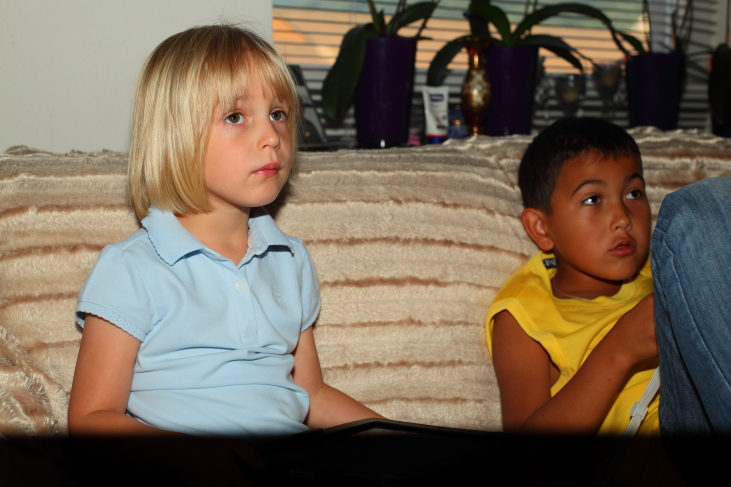
I mounted the gun on my camera and took a series of test pictures of Viktoria and Nikita who were on the couch next to me. I began at 1/60 sec which was fine. The flash covered the whole of the sensor without any curtain cut off. 1/125 sec was the same, as was 1/250 sec. The curtain only showed itself when I shot the two children at 1/320sec as you can see from the illustration.

1/125 sec @f5.6

1/250 sec @ f5.6

1/320 sec @f5.6


So anyway. I could use the flash on camera outside at a speed of 1/250 sec without any fear of curtain cut off.

I shot all the test images with the camera set at ISO 400 and an aperture of f5.6. The Vivitar is simplicity itself to use. First you "tell" the unit what film speed you are going to be using. The ISO speed ranges from 25 to 400. Then choose which of four apertures best suits what you're going to be photographing.


Apertures with ISO 400 are 5.6, 8, 16 or 22

 With yellow selected, the aperture to use is 5.6

As you can see, the apertures to use are coloured either yellow, orange, blue or purple.  After choosing a suitable aperture, you select it on the sensor ring which is on the front of the body under the flash head, and take the picture.


The unit can also be used off camera when coupled with the off camera cable.

As I mentioned earlier, I've had my 283 for many years. I'm sure that it's stuill be going strong ten years from now

A quote from Wikipedia which mentions the 283: "
The Vivitar 283 quickly became the number one professional and enthusiast flash unit, outselling all its competitors combined and selling 3,000,000 by 1973. In production for over 30 years, it was twice returned to production after being discontinued in response to customer demand."


There's a very nice review of the 283 to be found here and here

* I know that flashes don't really need to "get used" to anything but I was always told in my younger days to fire the flash a few times if it had been stored for any length of time. Old habits die hard.


Thanks for reading

Friday, 27 May 2011

One wedding and a reshoot

Two weekends ago I was asked to photograph a wedding for a very good friend of mine. 


Raphaela was marrying her fiance Lars, and as I've known her since 2002 and done previous photographic work for her, she was pleased when I accepted her offer to be both guest and photographer.


Raphaela asked me to provide documentary style coverage with a few of the "regular" pictures of parents and family etc thrown in. She didn't want the images presented in a traditional album but instead would use an online printing service to make a photobook.


The ceremony was due to take place at 13:00. I turned up bright and early at 09:30 and started my work. The pictures I took at the house included her getting here hair done, getting dressed and leaving for the church.


Everything went well until after the church. I had planned to get some shots of the couple outside the church but it began to rain so we went on to the post wedding Apèro. 


After the post wedding Apèro we all headed 58 kilometers to the reception. the weather got progressively worse and by the time I reached the hotel where the reception was to be held, it was pouring down.


To add to my worries, there were no free rooms at the hotel where I could make some nice portraits of the couple.


I explained to Raphaela and Lars that i wouldn't feel that I had done a complete job unless I had some nice intimate pictures of the two of them.


Watching the sky getting progressively darker and the rain getting heavier, I had an idea.


"How about you both just enjoy yourselves tonight and I'll come by your place next week and get some pictures of the two of you?" I suggested.


Raphaela explained that they wouldn't be having a honeymoon until later in the year so my plan seemed like a winner.


Breathing a heavy sigh of relief, I concentrated on covering the party. And what a party! There were games, an Elvis impersonator, a belly dancer and lots lots more. Raphaela and her guests certainly know how to enjoy themselves  :o)


 Elvis is on the floor  Uh Huh.

Raphaela is a big Elvis fan

 Time for Ulrika the belly dancer

 Nadja gets to grips with the belly dancer

 Everyone enjoyed themselves


Young and old as well


At the end of the evening (which was 02:30 for me), I had shot 680 images with my EOS 7d and the EOS 5d. The next day I looked through them using my Canon DPP software and had to reject 47, due to either the flash not activating or (mostly) Raphaela blinking!


As an aside. In the "old days" when I shot film at a wedding, I would ask my subject after taking their photo, to close their eyes and tell me if they could see purple blobs. If the answer was yes, then their eyes had been open when the flash activated. Nowadays I just check the monitor.


I shoot everything in RAW so my (very simple) workflow consists of pressing CTRL + A to select all the files, sharpen them all, give them all a half a stop underexposure, correct the lens aberrations, convert the lot into 300 dpi JPG's then go and have a cup of tea!


The day of the reshoot was yesterday. The sky clouded over again and for a very short while it threatened to rain. 


However, after a short wait the threat subsided and we began our "sequel".


Raphaela told me afterwards that the shoot was much more relaxed and stress free as there wasn't an actual ceremony and guests to worry about. This was evident to me because of the constant joking and smiles.


I used the EOS 7d for this shoot as my EOS 5d is getting fixed. This is a very small selection of what we took.


 EOS 7d, 430 EX flash and 28 -135 lens

  EOS 7d, 430 EX flash and 17 - 40 lens


   EOS 7d, 430 EX flash and 17 - 40 lens


   EOS 7d, 430 EX flash and 17 - 40 lens


   EOS 7d, and  70 - 200 lens


  EOS 7d, 430 EX flash and 17 - 40 lens


I took 121 images of which 107 went to the couple. Raphaela's blinking meant that I had to discard the other 14!!


That's it for now. Thanks for reading and please leave a comment.