Friday, 21 January 2011

Reflection

Last week whilst walking through the town of Zofingen, I saw this painting in a shop display window.

What intrigued me was the reflection from the window which showed the same scene.

Couldn't resist making a snap.

 A painting and a reflection

Have a great weekend.

Wednesday, 19 January 2011

Earning and shooting bread...

Interesting problem last week.

The company I work for has developed a range of LED lights which can be adjusted to complement various products from meat to designer textiles.

There's a setting for meat to bring out the succulent bloodiness of fresh produce on a butcher's counter to accents to subtly highlight delicate fabrics on a mannequin in a shop window. The lights can also be dimmed without losing colour.

Anyway, I digress.

We discovered at the last minute that there wasn't a suitable image of bread that we could use. I solved this by going to the bread department of a shop where the lights are already installed and working successfully.

The baker in charge gave me a selection of products to play with and I arranged them on a wooden palette. I set the EOS 5d on my Benbo and shot the buns in a vertical orientation because I knew from studying the layout that this would be ideal. My 28 - 135 zoom allowed me to crop tightly and fill the frame as envisaged by our art department.


The setup recorded with my Samsung Galaxy

That finished, I returned and they are now, as I write this, being incorporated into a brochure.

 Close-up. Again taken with the Galaxy

 That's it for now. My next assignment is to shoot some meat and a range of designer lights.

By the way. If you want to know more about these LED lights, my company has produced a microsite where all your questions will be answered. You'll find it here.

Thanks for reading.


Tuesday, 11 January 2011

My favourite fourteen

I’ve just been sorting through the images that I took last year in my job as photographer for Regent Lighting here in Switzerland.

I took literally thousands of images and these have now all been categorised, sorted and saved along with their associated backups etc.

I was distracted by reading some of the many “best of” type posts that inevitably appear every year’s end on the ‘net and in print.

With that in mind I decided to choose my favourite images taken in the course of my work last year and remark on a few of them.

All were taken with my Eos 5d. I used my 17 – 40 F4, the 28 – 135 or my 24mm f2.8. The 17 – 40 proved the most popular with the majority taken using that lens.

My work, when I’m on location requires that I reproduce the lighting effects as faithfully as possible. That means no extra lighting. Just me, the camera, a lens and a tripod. Sometimes it’s relatively straightforward such as photographing at dusk of an exterior building lit from out or inside.

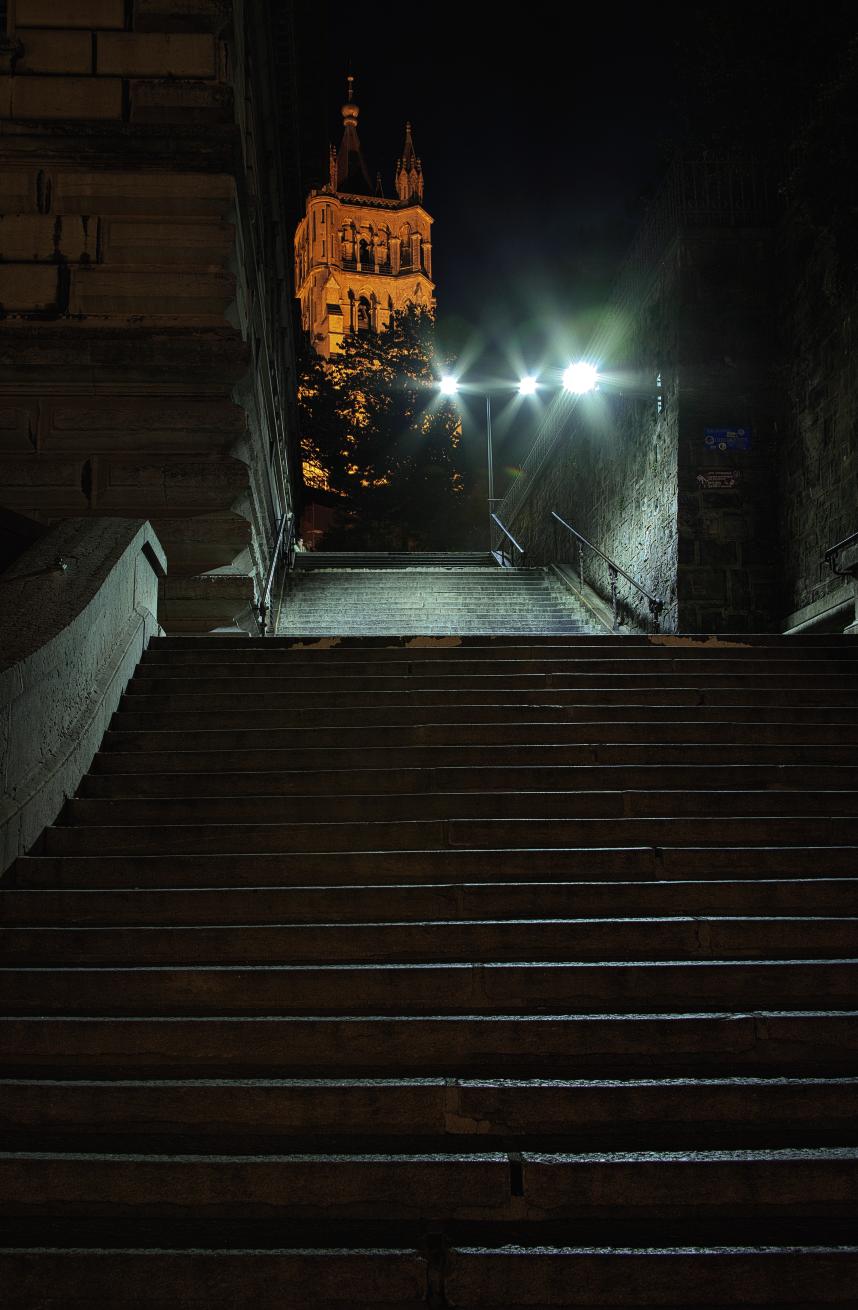
These images were all taken using the HDR method of combining three exposures and blending them into one in which details can be seen everywhere.
 Bracketed exposures of 2.5, 1 and 6 seconds. f10
400 ISO. 28 - 135 zoom at 28mm setting.


 Bracketed exposures of 2.5, 1.3 and 5 seconds. f13
400 ISO. 17 - 40 zoom at 17mm setting.


Sometimes however, it gets a tad trickier. I will have to photograph a room where the lights are burning. A “normal” exposure will lead to the lights being “burnt out” on the picture. The same is true if there is a window in the shot, as the daylight can often burn out and look false. This is where HDR again comes to the rescue rendering details in the highlights and shadows.


  Bracketed exposures of 1, 1/2 and 2 seconds. f18
200 ISO. 17 - 40 zoom at 17mm setting


 Bracketed exposures of 1/2, 1/4 and 1 second. f18
400 ISO. 24mm Lens

 Bracketed exposures of 1/2, 1 and 2 seconds. f18
400 ISO. 24mm Lens
  
Bracketed exposures of 1.3, 1.5 and 3 seconds. f13
400 ISO. 17 - 40 at 17 mm setting


  Bracketed exposures of 1/4, 1/2 and 1/8 seconds. f20
125 ISO. 17 - 40 zoom at 17mm setting

Bracketed exposures of 1/5, 1/10 and 2.5 seconds. f18
200 ISO. 17 - 40 zoom at 17mm setting


Lastly there are street scenes which are also helped with the HDR method.


Bracketed exposures of 5, 2.5 and 10 seconds. f13
200 ISO. 28 - 135  zoom at 28mm setting
 
 Bracketed exposures of 2.5, 1.3 and 5 seconds. f10
400 ISO. 28 - 135 zoom at 38mm setting


 Bracketed exposures of 2.5, 1.3 and 5 seconds. f10
400 ISO. 28 - 135 zoom at 28mm setting


The only image amongst my favourites for 2010 that wasn’t an HDR is this one.

 Single exposure of 13 seconds. f13
400 ISO. 17 - 40 zoom at 17mm setting

I did make three images but ended up choosing this one as there were enough details already. You can read about the circumstances regarding the taking of this image in a previous blog post here.

All images were taken one of the three lenses mentioned above, normally at the widest setting (in the case of the zooms) with the camera on manual and set to f 10 or above

The 17 – 40 and the 28 – 135 are both nice sharp, contrasty lenses. The only corrections I’ve made are for distortion where the edges of wall etc., are curved. To correct this distortion I use “PT lens” from Tom Niemann. This can be used as a standalone programme or as a plug in for Photoshop. The newer versions of Photoshop have (I believe) this functionality built in. I however am using Photoshop version 7.0. It is a fantastic programme and recognises the camera and lens in use. It then corrects automatically or the user can further refine it. New lenses and Bodies are constantly being added. Take a look. It’s well worth the price.

That's it for now. As usual I appreciate your taking the time to read this and would welcome some comments.
Happy 2011.


Wednesday, 1 December 2010

My reputation was saved by a ZSD.

Last week I was looking through some of my old press stuff from the days in the early eighties when I freelanced in London for some twelve different publications.

Looking at the images bought back many memories of various jobs and situations etc, which I'm quite happy to share here (even the embarrassing ones).

One job in particular sprang to mind. I was asked to provide pictures in  colour for Hello magazine and black and white for the City of London Recorder newspaper.

The job itself was to photograph the Queen visiting the New Royal Mint premises.

On the day of the visit, I arrived in plenty of time and secured myself a good vantage point. The photo pass that I was issued only allowed me to photograph the Queen outside.  The indoor shots would be taken by another photographer

I was using my Canon A1 and the T90.The A1 was loaded with Ilford HP5 black and white film rated at 400 and the T90 was filled with Ektachrome 400 slide film. My reasons for the film in each camera was that I wanted to use the spot metering capability in the T90 to make sure that I was exposing correctly for the skin tones. Essential with unforgiving slide film.  The black and white, I would develop myself later as the newspaper was only printed once a week.

I opened the back of the A1 and threaded the film tongue into the take up spool, wound one frame on and then closed the back. I then fired off a couple  more frames until the mechanical counter showed number one in the small window.  Then I opened the back of the T90 and laid the tongue of the Ektachrome film against the take up spool. I closed the door and heard the film being automatically loaded. Thus set, I waited for The Queen to arrive.

HM always attracts a good crowd and I shot lots of pics of her with her subjects alternating between the two cameras. My window of opportunity was however all too brief and before a few minutes had passed, the Queen had gone inside.

I looked at the film counters on both cameras. The A1 had made 27 images and the T90 was nearly full with 34 frames gone. I put both cameras back in my bag and drove to Joe's Basement in Wardour Street SOHO to have the slide film developed. Joe's was a photolab that was open 24 hours a day. You could go in at one o'clock in the morning, hand in your slide film and have it back two hours later. They also did push processing, printing, mounting and lots of other photography related things.

I gave my film over the counter at 11:00 o'clock and was told that it would be ready by one. This was ideal because I had an appointment to hand in the best slides to the magazine at two thirty.

This meant I could go home, get some lunch, come back and pick up the slides then take them to the magazine with plenty of time to spare.

When I got home, I took the A1 from my bag and went to rewind the film. I pushed in the tiny film release button and lifted the lever on the film spool to begin the process.

Normally, for a thirty six exposure film, I would have to turn the handle about thirty or so times until it went slack, indicating that the film was back safely inside the cannister. This time however I felt the tension loosen after about two turns!

Shock!

Horror!

This could only mean one thing. The film had not gone through the camera. I had no black and white images for the newspaper. I felt sick. In the photography world, you are only as good as your last job. I had made a stupid amateur mistake and would be a laughing stock. No-one would employ a freelancer who didn't check if his film was loaded. What could I do? I began to formulate excuses but each one sounded more absurd that the previous one.

Then I had an epiphany. A simple solution came to me. I remembered that a couple of months  previously, I had bought myself an Ohnar Zoom Slide duplicator (ZSD) from Jessops photoshop on Tottenham Court road. This was a tube, containing a fixed focus lens at f22 that fitted on the front of an SLR and enabled the user to insert a slide at the front end in order to take a picture of the resuting image. There were two types. A fixed focal length and a zoom version. I had paid about £25 for the zoom version.

 Zoom slide duplicator. Image by Delgibo on Flickr


It was now nearly time for me to pick up the slides from Joe's. I grabbed my T90 , the ZSD and a roll of HP5 then made my way to Wardour Street. The slides were in my possession at one fifteen.

At about one thirty,  I made my way to one of the sit down cubicles in the mens toilet at Hello magazine. The next half an hour or so, saw me sitting on the toilet with my camera, ZSD attached,  pointed at a light bulb. I fed the best slides into the ZSD, zoomed in to crop and pressed the shutter, thus making a black and white copy of each colour image.

At two twenty five, I was able to hand over the colour images to the picture editor at Hello magazine.

That evening, I processed and printed the black and white images and handed the pics to my editor.


 Colour image from T90
Black and white copy from ZSD

 Ektachrome original

HP5 copy from ZSD


Reputation intact. Until next time that is!   ;o)