Friday, 21 September 2012

Workhorse. The Vivitar 283

A couple of weeks ago I needed to take some pictures in a hurry and what's more, they had to be illuminated by flash.

No problem. I have two Speedlite 430 EX II's at my disposal. Except I didn't! I had got in late the night before and left my camera case in my car. My camera case is full of the extras that I don't need to carry around all the time in my rucksack. To compound matters, my car was being serviced.

Oh well. There are always solutions that can be found if you think hard enough.

I remembered that I had a Vivitar 283 in my loft. The 283 has been in my possession for over twenty years now. I used it when freelancing back in the UK in the nineties.

A quick trip up a ladder to retrieve the flash and I was soon installing four penlight batteries into it.


I switched it on and was pleased to hear the high pitched whistling noise that denoted the capacitor was filling up. After ten seconds I was rewarded with an orange light which meant that the flash was ready for action.

I set the flash to manual and activated it four or five times to let the flash "*get used to" being on active service again.

Next I had to test it with my EOS 5DII. A quick search on the 'net informed me that the shortest flash synch speed was 1/200sec for shoe mounted flashes. Studio strobes apparently need a slower speed.

I mounted the gun on my camera and took a series of test pictures of Viktoria and Nikita who were on the couch next to me. I began at 1/60 sec which was fine. The flash covered the whole of the sensor without any curtain cut off. 1/125 sec was the same, as was 1/250 sec. The curtain only showed itself when I shot the two children at 1/320sec as you can see from the illustration.

1/125 sec @f5.6

1/250 sec @ f5.6
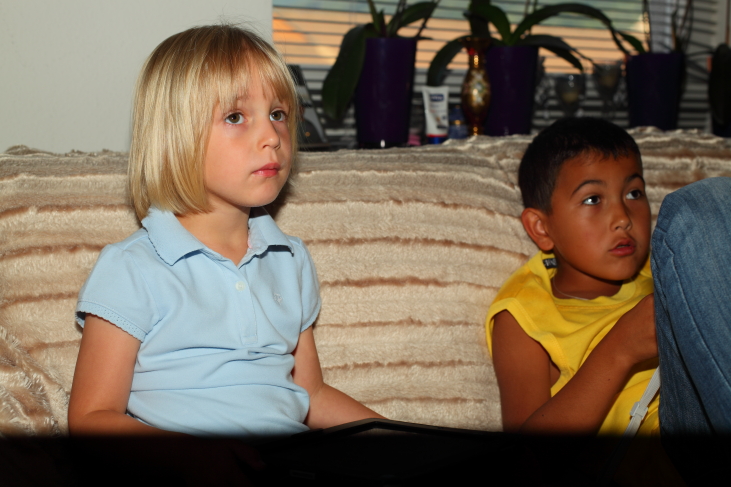
1/320 sec @f5.6


So anyway. I could use the flash on camera outside at a speed of 1/250 sec without any fear of curtain cut off.

I shot all the test images with the camera set at ISO 400 and an aperture of f5.6. The Vivitar is simplicity itself to use. First you "tell" the unit what film speed you are going to be using. The ISO speed ranges from 25 to 400. Then choose which of four apertures best suits what you're going to be photographing.


Apertures with ISO 400 are 5.6, 8, 16 or 22

 With yellow selected, the aperture to use is 5.6

As you can see, the apertures to use are coloured either yellow, orange, blue or purple.  After choosing a suitable aperture, you select it on the sensor ring which is on the front of the body under the flash head, and take the picture.


The unit can also be used off camera when coupled with the off camera cable.

As I mentioned earlier, I've had my 283 for many years. I'm sure that it's stuill be going strong ten years from now

A quote from Wikipedia which mentions the 283: "
The Vivitar 283 quickly became the number one professional and enthusiast flash unit, outselling all its competitors combined and selling 3,000,000 by 1973. In production for over 30 years, it was twice returned to production after being discontinued in response to customer demand."


There's a very nice review of the 283 to be found here and here

* I know that flashes don't really need to "get used" to anything but I was always told in my younger days to fire the flash a few times if it had been stored for any length of time. Old habits die hard.


Thanks for reading

Tuesday, 7 August 2012

Reflecting on keeping it simple

Back in June and early in July, I wrote about an impromptu photo session with Kristina. The gear I used couldn't have been simpler.

A camera body (in my case, the EOS 5d MKII), a standard 50mm lens, a flash (Speedlite 430 EXII) and a silver reflector.

Although I have a backpack full of camera gear I chose to work as simply as possible because it would make me concentrate on the picture and the framing as I wouldn't be able to zoom back and forth.

The shoot was in my bedroom at home and I spread two black fur blankets on the bed for a minimalist, non intrusive background. 

The bedroom faces west and because the shoot took place in the afternoon, we had strong light coming through the window which wasn't necessarily a good thing!

I posed Kristina mostly with her back to the light source to give her blonde hair some backlighting. This of course threw her face into shadow. This was solved with the aid of my Lastolite reflector. This reflector has been a constant in my camera bag for over twenty years. It is small, light and portable and a great help at "kicking" some light into the shadows.

 The reflector shown folded and open. 
This was the gear used for all three shoots
 
At the start of every pose, I would take a meter reading from her face with my aperture on the camera set to about f4. the ISO was set to 400. The exposure was then noted and transferred to manual mode. This was for two reasons. The exposure was unlikely to change and the wide aperture meant that the background would be slightly out of focus. Because of these parameters, I had to make sure that the eyes were always in focus. That's what people look at first on a portrait.

On this image, the reflector is just in front of  Kristina's 
knees throwing light back onto the face. f3.5 1/400sec

I was so please with the results that a few days later I received a call to take a basic head and shoulders portrait for a magazine story.

Although I had all my gear in the car, I turned up for the shoot with the above equipment.

To better show the difference when using and not using the reflector I took these two pics.
Before and after using the reflector 400 ISO
1/80 sec @f5.6

Of course you don't have to buy a reflector and can make your own. A colleague of mine used to use an A3 sized piece of card with aluminium foil stuck to it. Make sure though that it's the dull side that is reflecting and not the shiny side. The light will be softer and less prone to making your subject squint.
One negative aspect of making an A3 reflector as mentioned above is that it wasn't foldable, was cumbersome in the field and prone to getting scratched, torn etc. my advice would be to get a Lastolite or similar. take a look at their website. They have some interesting tutorials.

That's it for now. Hope you've enjoyed this piece. If you have any questions, please don't hesitate to ask.

Tom


Wednesday, 11 July 2012

Kristina part 2. Another impromptu photoshoot.

I wrote back in June about an impromptu photo session with my sister in law Kristina.

She visited again last week and I managed to persuade her to pose for me again. This time she was less self concious, especially after seeing the finished results from our last time together and this new attitude came across in the photos we made.


As before, I only used my Canon 5dMKII set at ISO 400 and coupled with a 50mm f1.4 lens.  My Speedlite was always bounced from the ceiling and a silver reflector was used to direct light back into her face when her back was facing the (window) light.

The complete set can be found on my website here.

Thanks for reading.


Tuesday, 3 July 2012

Back in time.

I recently attended a photo exhibition by an online colleague of mine Roger Albani. the event was held on the premises of a former watch making factory in Welschenrohr.

Sharing some of  the exhibition space on another part of the factory floor was an elderly gentleman surrounded by old blueprints, measuring devices and LOTS of watches in varying states of dismantlement.

 
After viewing Roger's images, I walked over to the other stand and began to inspect some of the very interesting and fully functioning devices there.

The owner of the stand turned out to be on Herr Alois Zäch who was responsible for development of the "Tourist" which was first illuminated wrist watch back in 1957 manufactured by the Tourist-Everlight Watch Company, Ad. Allemann Son, Welschenrohr, Switzerland.

 1957 advert for the 1st illuminated watch.

Herr Zäch had lots of stories to tell and was a mine of information about the "Tourist". He worked at the factory in Welschenrohr until it shut it's door in the late eighties and still has lots of memorabilia.

Some of the memorabilia includes the props used at the 1957 Basel fair to display the watches' illumination capabilities.

The advertising blurb says "illuminates the watch
 face and the surrounding area" The watch on this
 image (top left) is the one illuminated.

So. I hear you ask. "What has this to do with photography?" Well back in the day (as they say) I was always on the lookout for interesting articles to cover in order to hone my skills at reportage and also as a way of making money by sending said articles to magazines such as "Weekend", "Titbits" or maybe "Woman's Own".

I still have the urge, as a photographer to discover more about the world and the people around me and am not averse to asking questions. I decided there and then to do a little reportage on this interesting time in the Swiss watch making industry. Not to sell, but just to record and take some pictures.

Mr Zäch interested me because he represents a bygone era when electronics began to get smaller and smaller and be integrated into everyday items.

I took all the images that day with my 5D MkII and a 50 mm f1.4 lens.

(Left) original press release for the Tourist debut at
 the Basel fair in 1957. (Right) blueprints and watches.
Also on display was the battery charger. At that time, the watch didn't use small button cells as is the norm today. Instead, you had to hook it up to a charging device.

   Two images showing the charger open and closed.

And last but not least. The reportage would not be complete without a  photo of the man himself.

Herr Alois Zäch


Here's an excerpt from "WATCH. History of the modern wrist watch. By Pieter Doensen"
The first watch with a display illuminated by a small lamp of 1.2 mm, is the 'Tourist Everlight' of Ad. Allemann Fils S.A. of Welschenrohr, Switzerland. Three models were shown at the 1957 Basle Fair: a steel, goldplated and 18 K gold version. A small lead battery, the 'DEAC Dry-Accumulator' had to be recharged by a normal 1.5 V battery. In the United States, the 'Robot Everlight' was distributed by Robot Time New York.

So all in all, a very interesting day. I got to see some interesting images by Roger and learnt a little bit about Swiss watch making innovation. Oh! On another note. On the way home I spotted a lovely little shrine beside the road and made a mental note to return and photograph it. More later.

Thanks for reading.