Tuesday, 11 January 2011

My favourite fourteen

I’ve just been sorting through the images that I took last year in my job as photographer for Regent Lighting here in Switzerland.

I took literally thousands of images and these have now all been categorised, sorted and saved along with their associated backups etc.

I was distracted by reading some of the many “best of” type posts that inevitably appear every year’s end on the ‘net and in print.

With that in mind I decided to choose my favourite images taken in the course of my work last year and remark on a few of them.

All were taken with my Eos 5d. I used my 17 – 40 F4, the 28 – 135 or my 24mm f2.8. The 17 – 40 proved the most popular with the majority taken using that lens.

My work, when I’m on location requires that I reproduce the lighting effects as faithfully as possible. That means no extra lighting. Just me, the camera, a lens and a tripod. Sometimes it’s relatively straightforward such as photographing at dusk of an exterior building lit from out or inside.

These images were all taken using the HDR method of combining three exposures and blending them into one in which details can be seen everywhere.
 Bracketed exposures of 2.5, 1 and 6 seconds. f10
400 ISO. 28 - 135 zoom at 28mm setting.


 Bracketed exposures of 2.5, 1.3 and 5 seconds. f13
400 ISO. 17 - 40 zoom at 17mm setting.


Sometimes however, it gets a tad trickier. I will have to photograph a room where the lights are burning. A “normal” exposure will lead to the lights being “burnt out” on the picture. The same is true if there is a window in the shot, as the daylight can often burn out and look false. This is where HDR again comes to the rescue rendering details in the highlights and shadows.


  Bracketed exposures of 1, 1/2 and 2 seconds. f18
200 ISO. 17 - 40 zoom at 17mm setting


 Bracketed exposures of 1/2, 1/4 and 1 second. f18
400 ISO. 24mm Lens

 Bracketed exposures of 1/2, 1 and 2 seconds. f18
400 ISO. 24mm Lens
  
Bracketed exposures of 1.3, 1.5 and 3 seconds. f13
400 ISO. 17 - 40 at 17 mm setting


  Bracketed exposures of 1/4, 1/2 and 1/8 seconds. f20
125 ISO. 17 - 40 zoom at 17mm setting

Bracketed exposures of 1/5, 1/10 and 2.5 seconds. f18
200 ISO. 17 - 40 zoom at 17mm setting


Lastly there are street scenes which are also helped with the HDR method.
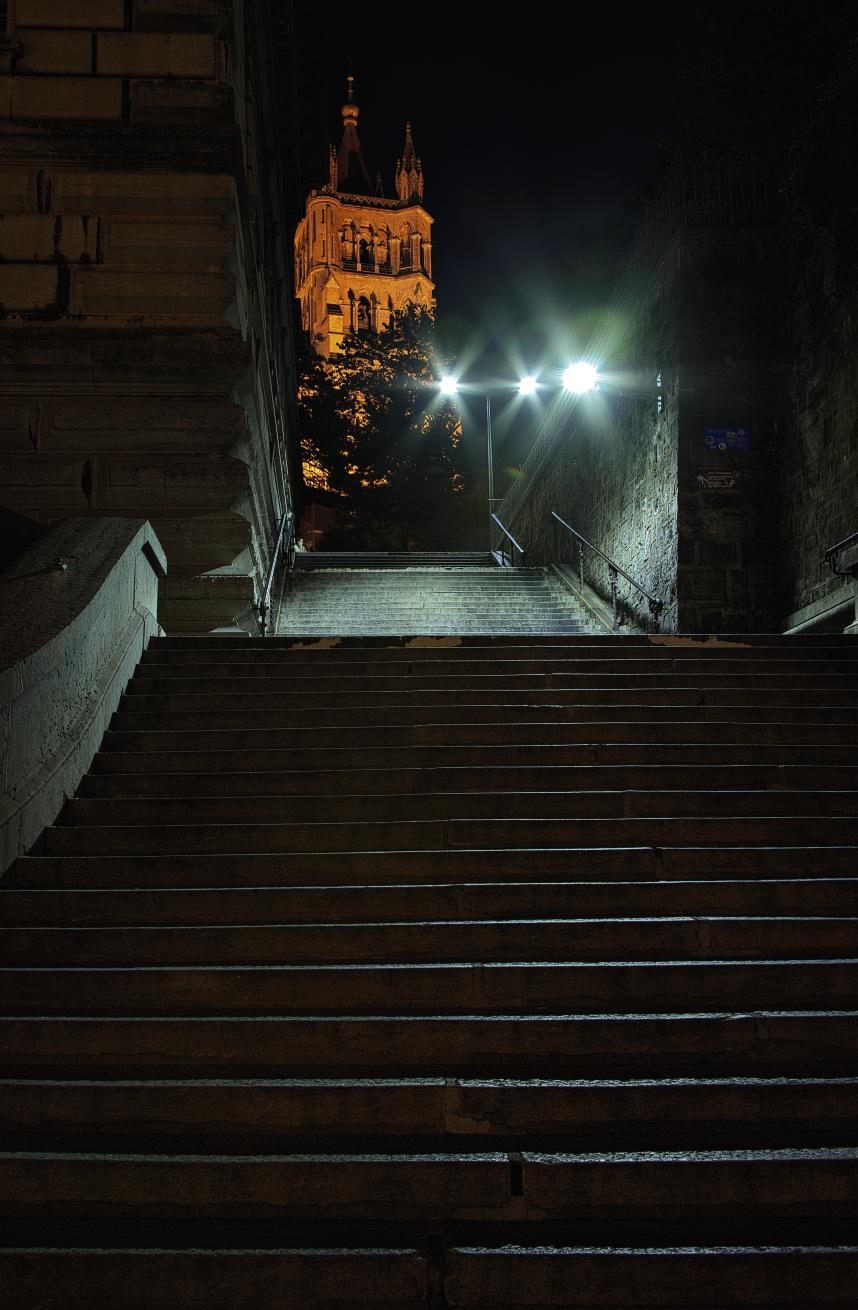

Bracketed exposures of 5, 2.5 and 10 seconds. f13
200 ISO. 28 - 135  zoom at 28mm setting
 
 Bracketed exposures of 2.5, 1.3 and 5 seconds. f10
400 ISO. 28 - 135 zoom at 38mm setting


 Bracketed exposures of 2.5, 1.3 and 5 seconds. f10
400 ISO. 28 - 135 zoom at 28mm setting


The only image amongst my favourites for 2010 that wasn’t an HDR is this one.

 Single exposure of 13 seconds. f13
400 ISO. 17 - 40 zoom at 17mm setting

I did make three images but ended up choosing this one as there were enough details already. You can read about the circumstances regarding the taking of this image in a previous blog post here.

All images were taken one of the three lenses mentioned above, normally at the widest setting (in the case of the zooms) with the camera on manual and set to f 10 or above

The 17 – 40 and the 28 – 135 are both nice sharp, contrasty lenses. The only corrections I’ve made are for distortion where the edges of wall etc., are curved. To correct this distortion I use “PT lens” from Tom Niemann. This can be used as a standalone programme or as a plug in for Photoshop. The newer versions of Photoshop have (I believe) this functionality built in. I however am using Photoshop version 7.0. It is a fantastic programme and recognises the camera and lens in use. It then corrects automatically or the user can further refine it. New lenses and Bodies are constantly being added. Take a look. It’s well worth the price.

That's it for now. As usual I appreciate your taking the time to read this and would welcome some comments.
Happy 2011.


Wednesday, 1 December 2010

My reputation was saved by a ZSD.

Last week I was looking through some of my old press stuff from the days in the early eighties when I freelanced in London for some twelve different publications.

Looking at the images bought back many memories of various jobs and situations etc, which I'm quite happy to share here (even the embarrassing ones).

One job in particular sprang to mind. I was asked to provide pictures in  colour for Hello magazine and black and white for the City of London Recorder newspaper.

The job itself was to photograph the Queen visiting the New Royal Mint premises.

On the day of the visit, I arrived in plenty of time and secured myself a good vantage point. The photo pass that I was issued only allowed me to photograph the Queen outside.  The indoor shots would be taken by another photographer

I was using my Canon A1 and the T90.The A1 was loaded with Ilford HP5 black and white film rated at 400 and the T90 was filled with Ektachrome 400 slide film. My reasons for the film in each camera was that I wanted to use the spot metering capability in the T90 to make sure that I was exposing correctly for the skin tones. Essential with unforgiving slide film.  The black and white, I would develop myself later as the newspaper was only printed once a week.

I opened the back of the A1 and threaded the film tongue into the take up spool, wound one frame on and then closed the back. I then fired off a couple  more frames until the mechanical counter showed number one in the small window.  Then I opened the back of the T90 and laid the tongue of the Ektachrome film against the take up spool. I closed the door and heard the film being automatically loaded. Thus set, I waited for The Queen to arrive.

HM always attracts a good crowd and I shot lots of pics of her with her subjects alternating between the two cameras. My window of opportunity was however all too brief and before a few minutes had passed, the Queen had gone inside.

I looked at the film counters on both cameras. The A1 had made 27 images and the T90 was nearly full with 34 frames gone. I put both cameras back in my bag and drove to Joe's Basement in Wardour Street SOHO to have the slide film developed. Joe's was a photolab that was open 24 hours a day. You could go in at one o'clock in the morning, hand in your slide film and have it back two hours later. They also did push processing, printing, mounting and lots of other photography related things.

I gave my film over the counter at 11:00 o'clock and was told that it would be ready by one. This was ideal because I had an appointment to hand in the best slides to the magazine at two thirty.

This meant I could go home, get some lunch, come back and pick up the slides then take them to the magazine with plenty of time to spare.

When I got home, I took the A1 from my bag and went to rewind the film. I pushed in the tiny film release button and lifted the lever on the film spool to begin the process.

Normally, for a thirty six exposure film, I would have to turn the handle about thirty or so times until it went slack, indicating that the film was back safely inside the cannister. This time however I felt the tension loosen after about two turns!

Shock!

Horror!

This could only mean one thing. The film had not gone through the camera. I had no black and white images for the newspaper. I felt sick. In the photography world, you are only as good as your last job. I had made a stupid amateur mistake and would be a laughing stock. No-one would employ a freelancer who didn't check if his film was loaded. What could I do? I began to formulate excuses but each one sounded more absurd that the previous one.

Then I had an epiphany. A simple solution came to me. I remembered that a couple of months  previously, I had bought myself an Ohnar Zoom Slide duplicator (ZSD) from Jessops photoshop on Tottenham Court road. This was a tube, containing a fixed focus lens at f22 that fitted on the front of an SLR and enabled the user to insert a slide at the front end in order to take a picture of the resuting image. There were two types. A fixed focal length and a zoom version. I had paid about £25 for the zoom version.

 Zoom slide duplicator. Image by Delgibo on Flickr


It was now nearly time for me to pick up the slides from Joe's. I grabbed my T90 , the ZSD and a roll of HP5 then made my way to Wardour Street. The slides were in my possession at one fifteen.

At about one thirty,  I made my way to one of the sit down cubicles in the mens toilet at Hello magazine. The next half an hour or so, saw me sitting on the toilet with my camera, ZSD attached,  pointed at a light bulb. I fed the best slides into the ZSD, zoomed in to crop and pressed the shutter, thus making a black and white copy of each colour image.

At two twenty five, I was able to hand over the colour images to the picture editor at Hello magazine.

That evening, I processed and printed the black and white images and handed the pics to my editor.


 Colour image from T90
Black and white copy from ZSD

 Ektachrome original

HP5 copy from ZSD


Reputation intact. Until next time that is!   ;o)


Monday, 15 November 2010

Always check and double check...

T'was way back in the eighties. I was stringing in London and providing images for some twelve different newspapers and magazines.

One particular day found me at a function for the Restricted Growth Asociation (RGA) . It was a standard job. Just get some pics of The Duchess of Gloucester with the children. I was also told that the children were not to be identified.

Bang on time, the Duchess arrived with the normal entourage including the Mayor of London and associated members of the RGA board.

I shot away with my Canon A1 and a Vivitar 283 flash (which incidentally I still have).

The duchess was being shown around by a gentleman who was also affected with restricted growth.

I took my pictures and made sure the include the aforementioned gentleman.

Afterwards, I went to take my notebook out of my bag but discovered that I had left it in my motorbike locker. Still. I knew the Lord mayor's details as I'd photographed him several times previously. Same for the Duchess of Gloucester. All I had to do was memorise the short gentleman's name and I could leave.

I approached one of the Duchess' ladies in waiting and enquired as to the name of the gentleman. She told me.

"Really?" I asked.
"Yes" she replied. "Easy to remember eh?"
"Yes" I answered and left to do another couple of jobs.

I finally got around to developing the film later that night but blame it on the fumes of the D76 developing fluid because I had a mental blank as to the correct name of the man in the photos when suddenly it came back! It certainly was an easy enough to remember name.

I left the pictures on the desk of my picture editor with the names and captioning details of everyone involved and went home to bed. right and early the next morning, I went into the newspaper offices and got talking to
the picture editor.

"Tom. Are you sure about the names on this picture?"
"Yes. Why do you ask? Is there a problem?"
"Well I think that you may have made a mistake on this gentleman's name"
"Which one?" I asked
"The chap standing by the Duchess. The short gentleman"
"Oh." I replied. "I asked his name and of of the entourage told me he is called "Winston
Churchill" that's easy enough to remember"
"You absolutely sure?" he again asked
"Like I said, it's easy enough to remember. Check it out if you want"

 Not Winston Churchill

It's a good thing that he did because when it finally appeared in print, he was given the correct name of " William Shakespeare! "


Thursday, 21 October 2010

62 degrees!!

An interesting problem presented itself last week when I was on location in the small town / village of Horn on the shore of lake Constance.

My brief was to photograph the Spa area of a luxurious hotel. The spa area has recently undergone a complete refurbishment and my friend, the lighting designer, Renato De Toffol, asked me to provide images of the finished lighting.

I arrived early and scouted the location which comprised indoor pool with a lake view, a sauna and a massage area. Due to the fact that the whole complex was still in use, I had to wait until ten in the evening to begin shooting to ensure that all the guests had gone.

After a meal in the restaurant, I collected my gear from the car and bought it inside. I attached my 17 - 40 zoom to a 5d body and entered the pool area. Condensation formed all over the camera and lens immediately due to the warm humid temperature in the pool area compared to the outside.


I didn't want to wipe the lens with a cloth in case it left smear marks.  Normally, I would have left it in the pool area to acclimatise but there was no time. The cleaning crew were anxious to begin work and there was lots to photograph.

Seeing an open fire nearby, I had an idea. I held the camera pointing lens first at the flames from about 50 cm (about 19 inches)away. After about three and a half minutes, the lens had cleared and I could start shooting.


The pool area with fire

After the pool area we moved to the sauna area. I opened the door of the main sauna and a wave of very hot and dry air hit me. I looked at the LED temperature readout on the wall. It was 80 degrees. That's 176 degrees Fahrenheit!!

As I was still dressed in jeans and a T-Shirt, I decided to cool the room a little before beginning my shoot. I tried opening and closing the door to try and "waft" the air out, but the building manager came and told me not to as it would trigger the fire alarms. The temperature was now somewhat "cooler" at 62 degrees. That's 143 fahrenheit.   :o)

 Somewhat warm

There was no other option but to go in and work through the heat. I set up my tripod and the sweat immediately began running down my back, my legs and dripped off my nose. The lighting in the sauna was quite dim and it was a struggle to focus. Even the built in autofocus was finding it difficult. Eventually I found that an exposure time of 13 seconds at f13 was just about right for the conditions with the ISO set at 400.

 The finished image. 13 sec at f13 at 62 degrees.


When I finished the sauna shoot my clothes were wet through and luckily that was the end of the shoot and I could get myself back to my hotel for a shower and a well earned sleep.